Is your website driving customers away? Learn the common problems that could be costing your business valuable enquiries.
Your website could be attracting visitors while quietly losing potential customers.
A visitor may arrive through Google, social media, an advertisement, or a referral. Within seconds, they form an impression of your business. If the website is confusing, outdated, slow, difficult to use, or doesn’t clearly explain what you offer, that visitor may leave before contacting you.
The good news is that many website problems can be identified and improved.
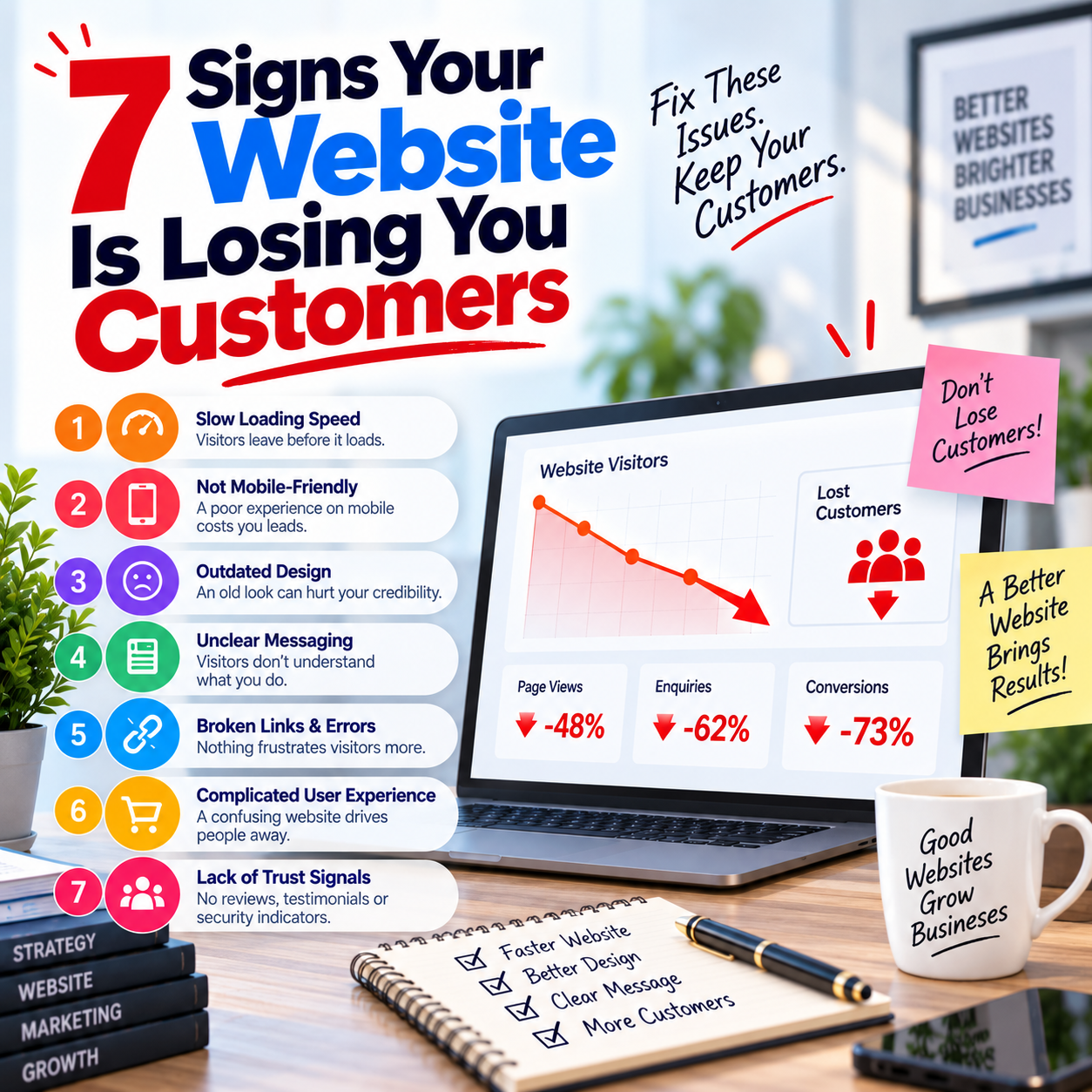
Here are seven common signs your website may be costing your business potential customers.
1. Your Website Looks Outdated
Design expectations have changed significantly over the years.
An outdated website may use cluttered layouts, old graphics, excessive text, poor spacing, or inconsistent branding. Even if your business provides excellent services, an old website can make your online presence feel less professional.
Modern website design isn’t about following every trend. It’s about creating a clean, clear, user-friendly experience that represents your business properly.
Your website should reflect the quality of the service you want customers to associate with your brand.
2. Your Website Isn't Mobile-Friendly
A potential customer may discover your business while using a smartphone.
If your website requires excessive zooming, has tiny text, poorly positioned buttons, or navigation that doesn’t work properly on mobile devices, the customer experience suffers.
Responsive web design allows your website to adapt to different screen sizes.
Important elements such as menus, images, forms, buttons, headings, and content should remain easy to use across smartphones, tablets, laptops, and desktop computers.
Mobile responsiveness should be considered a fundamental part of modern website design.
3. Visitors Don't Understand What You Do
One of the biggest website problems is unclear messaging.
When someone lands on your homepage, they should quickly understand:
- What your business does
- Who you help
- What services or products you provide
- Why they should consider your business
- What they should do next
If visitors have to search through several pages to understand your offer, they may simply move on.
Your homepage should communicate the essentials clearly and quickly.
4. Your Website Is Difficult to Navigate
A beautiful website isn’t useful if visitors can’t find what they need.
Navigation should be simple and logical. Important pages such as Services, About, Portfolio, Contact, Pricing, or Shop should be easy to locate where relevant.
For larger websites, organised menus and internal links become even more important.
A customer shouldn’t need to become a detective to find your contact form.
5. Your Website Doesn't Make Contact Easy
Imagine a potential customer is ready to enquire about your service but cannot find a contact option.
That’s a missed opportunity.
Your website should provide clear ways for customers to take action.
Depending on your business, this could include enquiry forms, quote requests, booking systems, ecommerce checkout, email links, or messaging options.
Calls to action should be visible without overwhelming the visitor.
6. Your Website Loads Slowly
People expect websites to respond quickly.
Large images, unnecessary scripts, poor hosting configurations, excessive plugins, and unoptimised content can contribute to slow performance.
Website speed isn’t just a technical issue. It affects the overall experience.
A slow website can frustrate visitors before they even see your services.
Optimising images, reducing unnecessary elements, improving code, and using appropriate hosting and caching can help improve performance.
7. Your Website Isn't Supporting SEO
Having a website doesn’t automatically mean customers will find it through Google.
Search engines need clear information about your business and individual pages.
Important considerations can include:
- Relevant page titles
- Useful content
- Logical headings
- Search-friendly URLs
- Internal linking
- Mobile responsiveness
- Technical performance
- Image optimisation
- Local business information
SEO is an ongoing process rather than a one-time website feature.
How Do You Know If Your Website Needs a Redesign?
Look at your website from a customer’s perspective.
Ask yourself:
Can I understand this business within a few seconds?
Does the website work properly on my phone?
Can I easily find the services?
Is it obvious how to make an enquiry?
Does the design represent the quality of the business?
Does the website load efficiently?
Does the content answer common customer questions?
If several answers are no, your website may benefit from an update.
Final Thoughts
Your website is often one of the first digital touchpoints between your business and a potential customer. Small problems can influence whether visitors stay, explore, enquire, or leave.
A website redesign isn’t simply about changing colours or adding a new homepage. It should consider design, content, navigation, performance, responsiveness, SEO, and the customer journey.
Web7 Solutions helps Australian businesses create modern, responsive, user-friendly websites designed around their brand, customers, and business goals.