
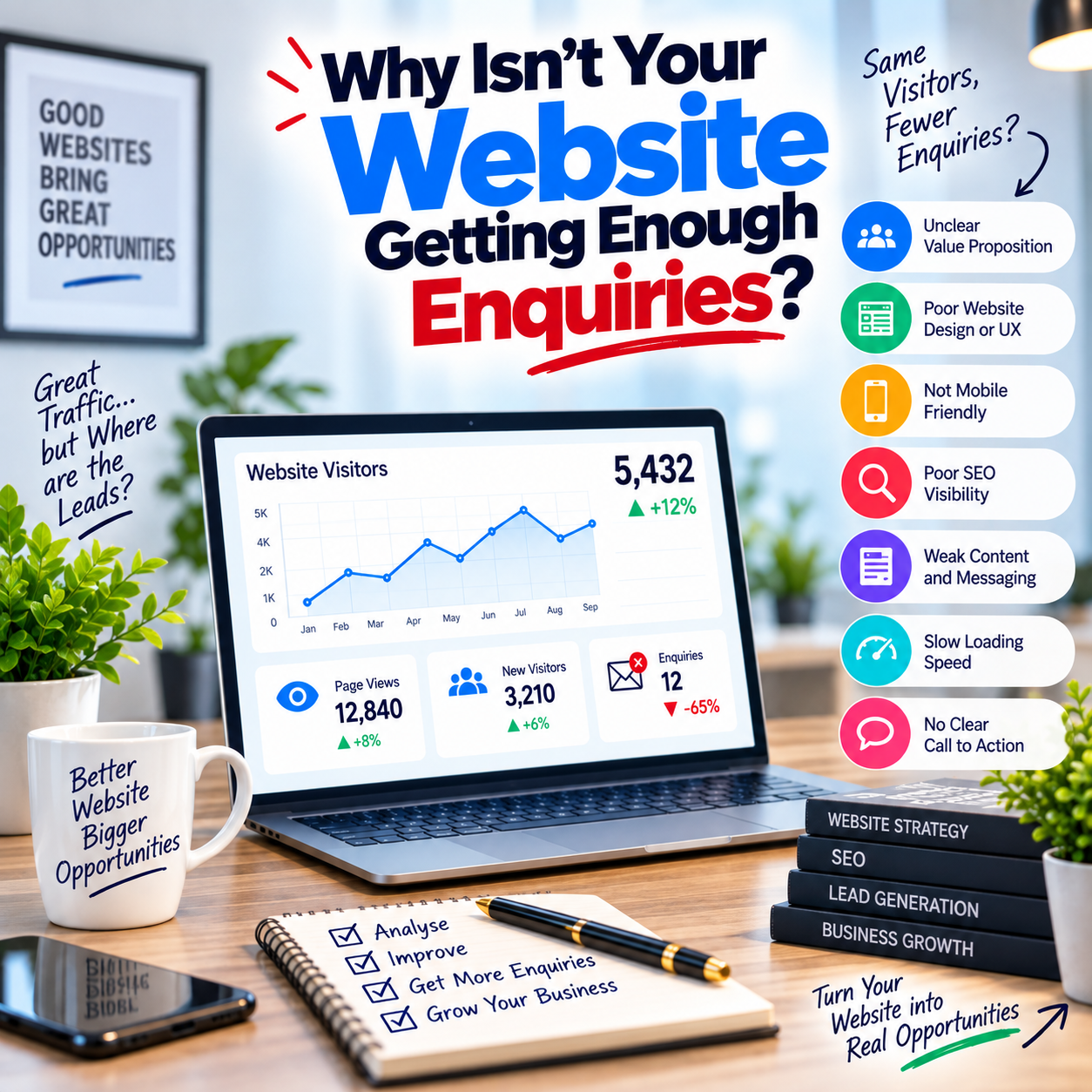
Find out why visitors may not be contacting your business and how better design, content, and user experience can help.
Getting people to visit your website is only the beginning.
The bigger challenge is turning those visitors into enquiries and potential customers.
You might have a modern-looking website, traffic from Google, visitors from social media, or people clicking your advertisements, yet still receive very few enquiries.
Why?
Often, the problem isn’t one single thing. It can be a combination of unclear messaging, weak calls to action, poor user experience, slow performance, limited trust signals, or content that doesn’t answer what customers actually want to know.
Let’s explore some common reasons.
Your Website Doesn't Clearly Explain Your Offer
When someone lands on your homepage, they shouldn’t have to guess what you do.
Your main message should clearly communicate your business, services, and value.
For example, instead of a vague statement such as “Quality Solutions for Every Need,” a business website could clearly explain the specific service it provides and who it serves.
Clear communication reduces confusion and helps visitors decide whether they’ve found the right business.
Your Calls to Action Aren't Clear
Visitors need a next step.
If someone wants to request a quote, how do they do it?
If they want to ask a question, where should they go?
If they want to purchase a product, can they easily find the shop?
Clear calls to action can guide visitors toward these actions.
Examples include:
- Get a Quote
- Request a Consultation
- Send an Enquiry
- Shop Now
- View Our Services
- Contact Us
The wording should match the customer’s intent.
Your Website Doesn't Build Enough Trust
Customers may hesitate to contact a business they don’t know.
Your website can help address this by providing useful trust signals.
Depending on the business, these might include:
- Customer reviews
- Testimonials
- Project photos
- Case studies
- Certifications
- Experience
- Business information
- Guarantees or warranties where applicable
- Service areas
Trust signals should be genuine and relevant.
Don’t add claims simply because they sound impressive. Provide information that helps customers make an informed decision.
Your Website Is Difficult to Use on Mobile
A customer may discover your business through their smartphone.
If the website is difficult to navigate on mobile, the visitor may leave before contacting you.
Check your website on different devices.
Can visitors read the text?
Can they open the menu?
Can they click buttons?
Can they complete the enquiry form?
Can they view your services without excessive scrolling or zooming?
A responsive design should provide a smooth experience across different screen sizes.
Your Content Doesn't Answer Customer Questions
Customers often have concerns before contacting a business.
They may want to know:
- What services do you provide?
- Where do you operate?
- How much does it cost?
- How does the process work?
- How experienced are you?
- What makes your service different?
- How can I contact you?
Your website content should address relevant questions clearly.
A useful FAQ section can also help remove uncertainty.
Your Website Is Too Slow
Performance matters.
Visitors don’t want to wait unnecessarily for pages to load.
Large images, excessive plugins, poor hosting, inefficient code, and unnecessary features can affect website performance.
Optimising images, reducing unnecessary elements, improving hosting, and using efficient website development practices can help create a smoother experience.
Your Website Doesn't Have the Right Traffic
More visitors don’t automatically mean more enquiries.
Imagine a business selling premium commercial services attracting thousands of visitors who are looking for something completely different.
The traffic may look impressive, but it isn’t necessarily useful.
SEO, advertising, social media, and other marketing activities should attract people who are relevant to your products or services.
This is why understanding your target audience is important before developing your website and marketing strategy.
Your Website Doesn't Match Your Brand
Your website should feel consistent with your overall business.
Your logo, colours, typography, photography, messaging, and tone should work together.
Inconsistent branding can make the business appear less established.
A strong website should communicate your brand visually and verbally.
What Can You Do?
Start by reviewing your website from the customer’s perspective.
Don’t only ask whether you personally like the design.
Ask:
Can customers understand what I offer?
Can they find the information they need?
Can they trust my business?
Can they contact me easily?
Does everything work properly on mobile?
Is the website fast enough?
Is the content attracting the right audience?
These questions can reveal areas for improvement.
Final Thoughts
A website can look attractive and still fail to generate enough enquiries.
Successful website design requires more than visual appearance. Messaging, structure, trust, functionality, mobile responsiveness, performance, SEO, and calls to action all contribute to the customer journey.
At Web7 Solutions, we design websites for Australian businesses with a focus on modern design, responsive functionality, user experience, and business goals—helping create digital experiences that make it easier for visitors to understand your business and take the next step.